A well-priced San Anselmo listing does not fade gently if it misses its window. It falls.
Spring 2026 closings on BAREIS MLS put a number on that fall. San Anselmo logged 56 single-family closings in that window at a median sale price of $1.8 million, and homes that sold within 30 days closed at 107.21 percent of their original list price, one of the strongest such premiums recorded anywhere in Marin this year. Cross into the next bracket, homes that took 31 to 60 days, and the average sale-to-list ratio drops to 92.8 percent. That is a 14-point fall in a single step, and there is almost no gentle middle ground between the two numbers. In a town where the median list price sits north of a million and a half dollars, 14 points is not a rounding error. It is real money, and it arrives fast.
Sellers who are only watching the town median miss this entirely. The median tells you what a house is worth. It says nothing about what happens to your specific house if it doesn't move in the first month.
The Math Behind the Cliff
Here is the split, stated plainly, from the same Spring 2026 window (closings between March 1 and June 1, 2026):
| Days on Market | Sale Price vs. Original List |
|---|---|
| 30 days or less (Sprint) | 107.21% |
| 31 to 60 days | 92.8% |
Eighty percent of San Anselmo's spring closings landed in that first bracket. The town rewarded speed more decisively than almost anywhere else in the county, and it punished delay just as fast.
For context, the countywide version of this pattern is real but slower to arrive. Across all of Marin's 615 single-family closings in that same window, homes that sold within 30 days closed at 105.33 percent of original list. Homes that dragged past 120 days closed at 84.12 percent, a roughly 21-point spread worth more than $380,000 on the county's median list price. That gap is dramatic, but it takes four months to open up. San Anselmo's version opens by day 31.
Mill Valley's premium runs even higher on the fast side, 109.7 percent for homes sold within 30 days, but its slower brackets aren't tracked with the same cliff-edge severity. San Rafael has a wide spread too, roughly 26 points, but it doesn't show up until homes cross 90 days. San Anselmo is the town where the clock runs out fastest. If your home is going to sell at a premium here, it needs to happen almost immediately.
Why the Fall Is So Sharp Here
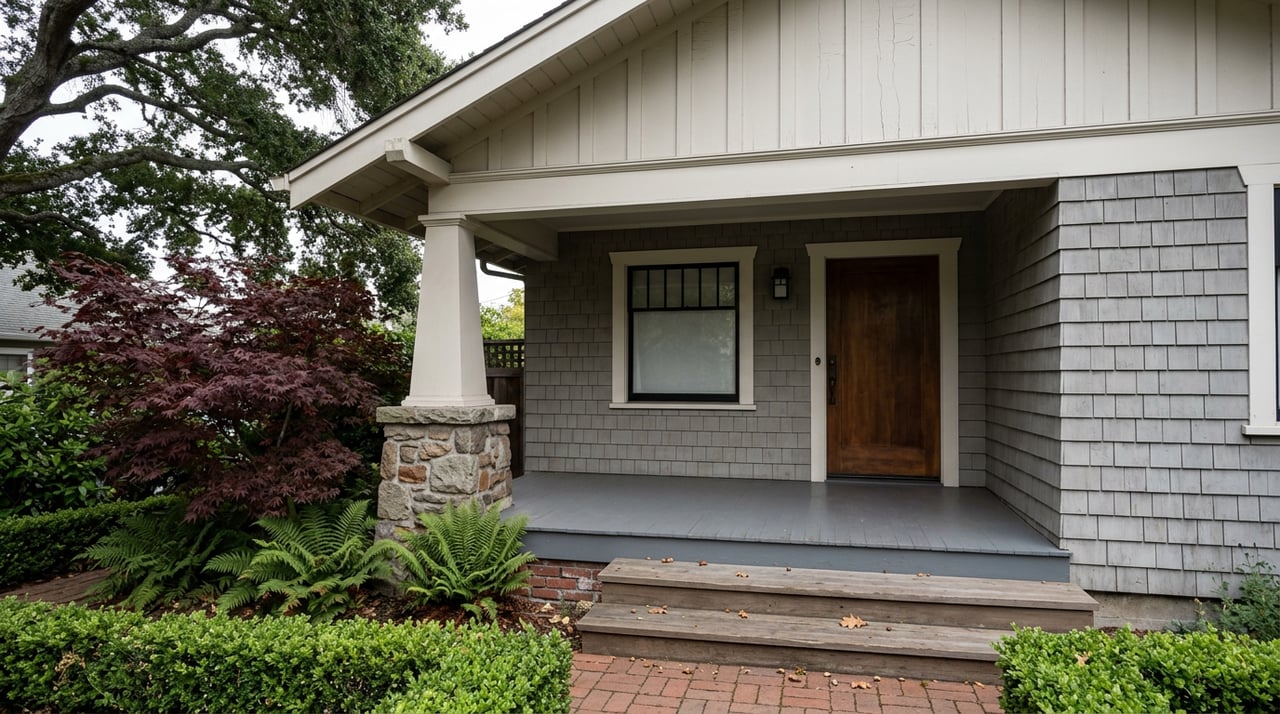
Most of San Anselmo's housing stock predates 1940. That single fact explains a lot of what makes this market behave differently from newer subdivisions in South Novato or the flatter tracts of San Rafael, where buyers are comparing floor plans. In San Anselmo, buyers are comparing character, and character is harder to fake once a house has sat on the market long enough for its flaws to show.
Two patterns keep repeating in how this plays out block by block.
The first is what happens to original detail. Homes that keep their Craftsman or Tudor-era bones intact, updated thoughtfully rather than gutted and rebuilt from scratch, draw a more committed buyer pool than remodels that strip out whatever made the house distinctive in the first place. Buyers here aren't just purchasing square footage. They're purchasing a specific kind of house, and a stripped-down version of it reads as a compromise rather than an upgrade.
The second is proximity to San Anselmo Avenue itself. The town grew up around what longtime residents still call the Hub, the old rail junction where Sir Francis Drake Boulevard, Red Hill Avenue, and Center Boulevard converge, a junction old enough that the town incorporated around it in 1907. The cottage stock within an easy walk of the Avenue tends to clear fastest of anything in town. Move west toward Seminary Hill, where streets climb above the 1890s stone halls that once housed the San Francisco Theological Seminary and now belong to the University of Redlands' Marin campus, or east toward the bungalow blocks that grew up around the old Yolanda rail stop, and the math shifts. These are still desirable pockets. They just don't clear on the same 30-day clock as the Avenue-radius homes do.
None of this means a home outside that radius can't sell well. It means the pricing and preparation have to account for a longer runway, and pretending otherwise is how a listing ends up sliding into that 92.8 percent bracket.
The Condition Item Nobody Prices Into the Offer
A Marin mortgage market note published this week called out San Anselmo by name for a reason that has nothing to do with price and everything to do with age. The advice was blunt: this town's housing stock is lovely, and that same age means appraisal condition items are close to guaranteed. Roofs, electrical panels, foundations, single-pane windows, the categories that show up on an inspection report in any home built before 1940. The note's guidance was to budget for these up front rather than discover them mid-escrow.
That timing matters more in San Anselmo than in a newer market because of the cliff itself. A home that goes under contract in the first two weeks rarely gives an appraiser or a buyer's inspector time to build leverage. A home that's still sitting at day 35 has already lost some of that momentum, and now a condition item surfaces on top of it. The seller who addressed the roof or the panel before listing is negotiating from a very different position than the one who's addressing it for the first time after an accepted offer.
This is also where San Anselmo differs from newer Marin developments in a way worth naming plainly: there are no Mello-Roos assessments here. The due diligence stack in this town is about the house itself, its age, its systems, its original detail, not about special tax districts layered on top of a subdivision. That's a simpler conversation to have with a lender, but it puts more weight on getting the home's physical condition documented and disclosed correctly before it ever reaches the MLS.
What the Median Headline Hides
Look at the aggregate numbers and San Anselmo appears to be softening. Redfin's data for the three months ending June 2026 shows the median sale price down 15.1 percent year over year, to $1.6 million. Zillow's broader home value index for the town sits at $1,661,705 as of June 2026, down 8.5 percent over the past year. Read in isolation, that looks like a town losing value.
Read the next line and the story changes. Over that same window, San Anselmo's median price per square foot rose 22.8 percent year over year. A falling median alongside a rising price per square foot is not a market getting cheaper. It's a market where the mix of what sold shifted, smaller homes moving through escrow instead of larger ones, pulling the median down even as the value of the square footage itself climbed.
Sleepy Hollow's small Eichler enclave illustrates why this distinction matters at the neighborhood level. That pocket, 15 homes built between 1972 and 1974 near Catskill Court and Katrina Lane, designed by architect Claude Oakland, trades in a tight $1.7 to $2.1 million range with what local listings describe as extremely low turnover. A town-wide median swing barely touches a market this small and this specific. If you're selling there, or in any of San Anselmo's other tightly defined micro-neighborhoods, the town's aggregate number tells you almost nothing about your own comp set.
The Takeaway for This Fall
The lesson isn't to panic about a falling median or to assume any price cut will fix a stalled listing. It's to recognize that in San Anselmo, the difference between a strong sale and a disappointing one is decided earlier than most sellers expect, inside that first month, before the cliff has a chance to open up. Getting there starts with pricing the home against its actual comp set rather than the town median, addressing age-related condition items before a buyer's inspector finds them, and being honest about whether the home sits inside the fast-clearing Avenue radius or in one of the pockets that needs a longer, more patient approach.
That's the kind of groundwork that doesn't show up in a portal search but shows up in the closing statement. If you're weighing whether to list this fall, or you want a second read on where your specific street falls on this map, I'd welcome the conversation. Melissa Crawford has spent more than two decades working these exact blocks, and knowing which side of San Anselmo's cliff a home is likely to land on is exactly the kind of judgment that comes from that time in the market, not from a median price alone.
Let's Connect.